
Senior High School GWA Without Units (Grade 11 & 12)
Last updated: July 2026 includes DepEd’s new SY 2026-2027 grading system
Table of Contents
Quick Answer
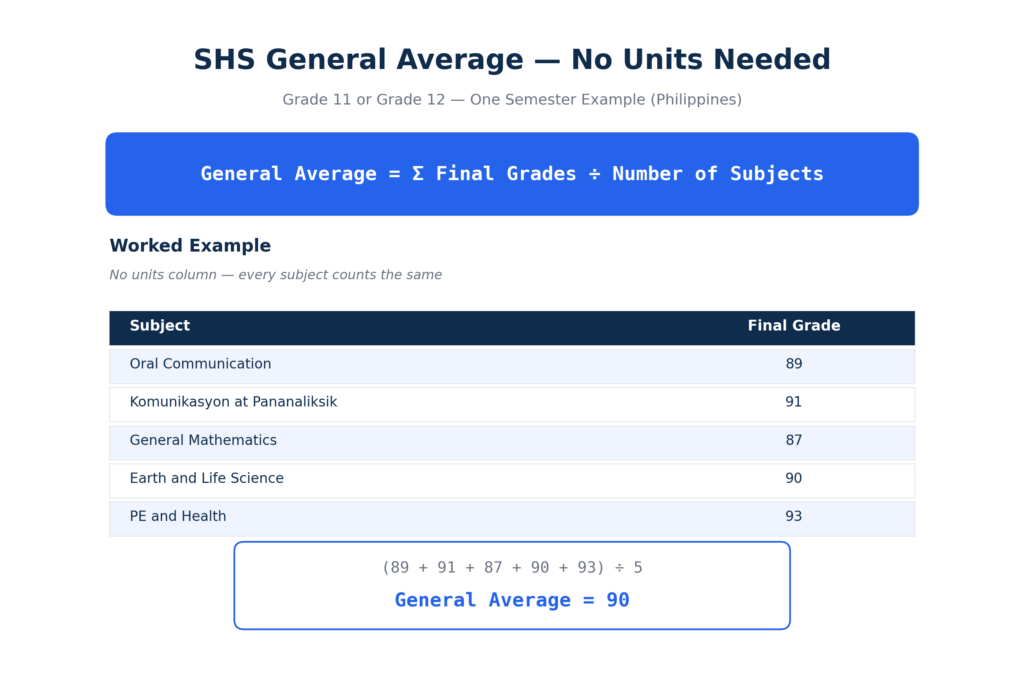
If your Senior High School report card has no “units” column, you’re not missing anything DepEd’s K-12 grading system doesn’t use units at all. Your General Average (what most students informally call their “SHS GWA”) is simply the average of your final grades across all subjects, with every subject counted equally:
General Average = Σ Final Grades ÷ Number of Subjects
No multiplying, no weighting just add up your final grades and divide by how many subjects you took. What did change for SY 2026–2027 is how each subject’s Final Grade itself gets built DepEd replaced the old grading order with DepEd Order No. 015, s. 2026 on June 4, 2026. Details below.
You can compute your General Average instantly with the GWA Calculator just enter 1 unit for every subject, which produces the exact same result as a simple average.
Why Your SHS Report Card Doesn’t Show Units
Units are a college concept, tied to credit hours and tuition computation. DepEd’s K-12 Basic Education Program which covers Kindergarten through Grade 12 never assigns academic units to individual subjects. Instead, every learning area is treated as a standalone subject with equal standing in your General Average, regardless of how many hours per week it’s taught.
This surprises a lot of incoming college freshmen, because their college Transcript of Records suddenly has a “units” column that directly affects their GWA something SHS report cards never had. If your school’s report card does list numbers next to each subject, they’re almost always time allocations (hours per week) for scheduling purposes, not grading weights. Confirm with your adviser or registrar if you’re unsure, but for the large majority of DepEd-aligned schools, those numbers don’t factor into your average at all.
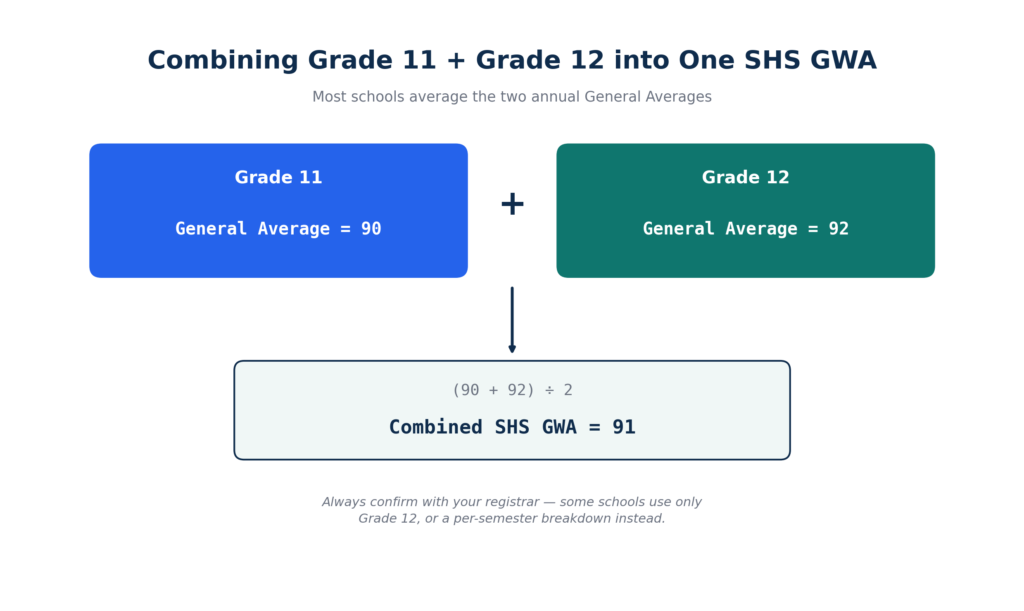
2026 DepEd Grading System Update What Changed
Most guides on this topic online still reference the old rules, so this section matters.
On June 4, 2026, DepEd signed DepEd Order No. 015, s. 2026 Revised Guidelines on Classroom Assessment, Grading System, and Awards and Recognition for the K to 12 Basic Education Program. It takes effect School Year 2026–2027 in all public schools nationwide (private schools are encouraged to adopt it too), and it officially repeals DepEd Order No. 8, s. 2015 the order that had governed K-12 grading since 2015 along with the old awards guidelines in DO 36, s. 2016.
Here’s what’s different for Senior High School:
1. New assessment components. The old Written Work / Performance Tasks / Quarterly Assessment (WW/PT/QA) model is replaced with WWs (Written/Oral Works), PTs (Product/Performance Tasks), and EXs (Examinations made up of Summative Test 1, Summative Test 2, and the Term Examination).
2. New weight distribution for SHS:
| Subject Type | WWs | PTs | EXs |
|---|---|---|---|
| Core Subjects & Academic Electives | 20% | 50% | 30% |
| Field Exposure / Arts Apprenticeship / Creative Production | 15% | 70% | 15% |
| Research Electives / Design & Innovation | 40% | 60% | — |
| Work Immersion | 20% | 80% | — |
3. Transmutation is changing (and eventually disappearing). For SY 2026–2027, schools use an Adjusted Transmutation Table an Initial Grade of 70.00 is now needed to convert to a passing Transmuted Grade of 75, a stricter baseline than the old table (which needed only a 60). Starting SY 2027–2028, DepEd moves to zero-based grading: your Term Grade comes directly from your computed Initial Grade, with no transmutation step at all, and 75 becomes the absolute minimum passing raw score.
4. Stricter Academic Excellence Award criteria covered in its own section below.
A transition-year caveat: if your school hasn’t yet rolled out the Strengthened Senior High School Curriculum for SY 2026–2027, DepEd allows it to keep using the old DO 8, s. 2015 weights for now, paired with the new Adjusted Transmutation Table. Some Grade 12 students this year may still see the old WW/PT/QA breakdown instead of WWs/PTs/EXs ask your registrar which version applies to you. Either way, this only affects how your individual subject grade is built, not how your overall General Average is computed.
The Official Formula (No Units Needed)
Regardless of which version of the subject-grade rules applies to you, your General Average is built in three steps:
- Each subject earns a Final Grade for the semester or quarter.
- All your Final Grades for that grading period are added together.
- The sum is divided by the number of subjects you took — not by units.
Worked Example (Grade 11, One Semester)
| Subject | Final Grade |
|---|---|
| Oral Communication | 89 |
| Komunikasyon at Pananaliksik | 91 |
| General Mathematics | 87 |
| Earth and Life Science | 90 |
| PE and Health | 93 |
Calculation: (89 + 91 + 87 + 90 + 93) ÷ 5 = 90
No units, no weighting every subject contributes exactly the same amount.
How Your Quarterly Grade Is Built
Before you get to the General Average, each subject’s Final Grade already reflects a weighted mix of assessment components. DepEd’s official process (per DO 015, s. 2026, Annex D):
- Get your Total Raw Score for each component (WWs, PTs, EXs).
- Convert to Percentage Score: PS = (Raw Score ÷ Highest Possible Score) × 100
- Compute the Weighted Score: WS = PS × the component’s assigned weight
- Add all Weighted Scores → your Initial Grade for the term.
- Apply the Transmutation Table (SY 2026–2027 only) to get your Quarterly Grade. From SY 2027–2028, this step is skipped entirely.
Worked example SHS Core Subject (WWs 20% / PTs 50% / EXs 30%):
| Component | Percentage Score | Weight | Weighted Score |
|---|---|---|---|
| Written/Oral Works | 85% | 20% | 17.0 |
| Product/Performance Tasks | 90% | 50% | 45.0 |
| Examinations | 82% | 30% | 24.6 |
| Initial Grade | 86.6 |
Under zero-based grading (SY 2027–2028 onward), this becomes your Final Grade directly, rounded to 87. For SY 2026–2027, it instead runs through the Adjusted Transmutation Table check your class record or ask your teacher for the exact converted value.
This is also why two students with identical exam scores can end up with different Final Grades: the mix of written output versus performance tasks versus exams varies by subject type and track. Once your Final Grade per subject is set, though, the General Average step that follows treats every subject equally this weighting only happens once, at the subject level, never at the General Average level.
Combining Grade 11 and Grade 12 into One GWA
Scholarship applications, college admissions, and some employers ask for a single “Senior High School GWA” that covers both years. DepEd doesn’t mandate one official method for this, but the most common approach used by schools and universities is straightforward:
Combined SHS GWA = (Grade 11 General Average + Grade 12 General Average) ÷ 2
Worked Example
- Grade 11 General Average: 90
- Grade 12 General Average: 92
Calculation: (90 + 92) ÷ 2 = 91
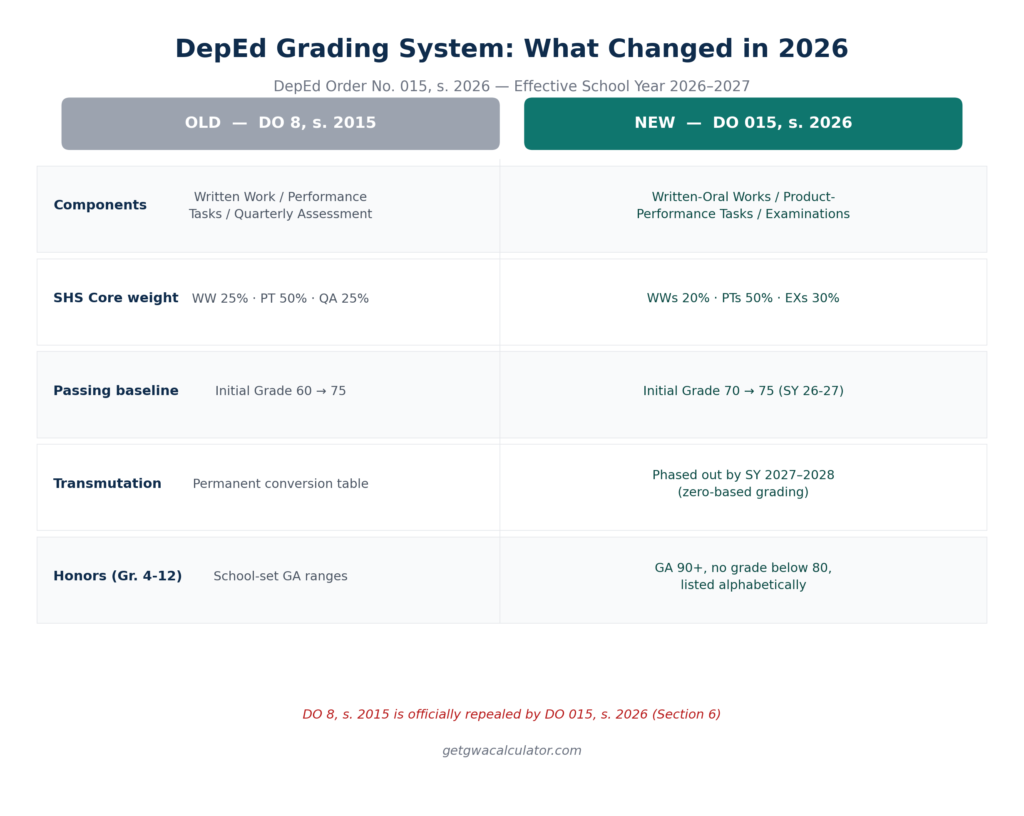
Important caveat: not every school or requirement uses this method. Some ask only for your Grade 12 final average (your most recent, most relevant year), while others want a semester-by-semester breakdown instead of an annual average. Before submitting any number labeled “SHS GWA,” always confirm with your school registrar or the requesting institution exactly which computation they expect the difference can matter for scholarship cutoffs.
When Some Schools DO Use Weights
While DepEd’s official K-12 policy doesn’t apply unit-based weighting, a number of private schools, and some Technical-Vocational-Livelihood (TVL) programs with heavier specialized subject loads, choose to apply their own internal weighting system sometimes assigning informal “units” based on hours per week, especially for specialized and applied subjects. DO 015, s. 2026 explicitly allows schools with specialized programs (science, sports, or arts high schools) to issue their own supplementary guidelines, as long as they stay consistent with the core principles of the order.
If your school does this, it will typically be stated in your student handbook or explained by your registrar it’s a school-level policy choice, not a DepEd requirement. When in doubt, ask your adviser directly: “Is our General Average weighted by units, or is it a simple average?” That one question resolves the ambiguity immediately.
SHS General Average vs College GWA
Once you reach college, the rules change completely grades switch to unit-based weighting on a 1.00–5.00 (or 4.00) scale instead of the 0–100 percentage scale used in SHS. For the full breakdown of how these two systems differ including the exact college formula and a side-by-side comparison table see our guide on GWA vs General Average.
Academic Excellence Awards in SHS
Honor criteria also changed under DO 015, s. 2026, which superseded the older DO 36, s. 2016 awards guidelines. To qualify for Academic Excellence Awards (Grades 4–12) now, a learner needs:
- A General Average of 90 or higher
- No Final Grade below 80 in any individual subject
- No derogatory disciplinary record
Award categories remain With Honors, With High Honors, and With Highest Honors, but awardees are now listed alphabetically instead of ranked, to reduce commercialized competition between students. Exact GA cutoffs distinguishing the three tiers are set at the school or division level within DepEd’s framework confirm your specific school’s brackets with your adviser.
This SHS honor system is separate from college Latin Honors (Cum Laude, Magna Cum Laude, Summa Cum Laude), which use an entirely different GWA scale and CHED-based framework Senior High School does not award Latin Honors.
FAQ
How do I compute my GWA in Senior High School if there are no units?
Add up your final grades for all subjects, then divide by the number of subjects. DepEd’s K-12 system doesn’t use unit-based weighting every subject counts equally, and this hasn’t changed under the new 2026 grading order.
What is the new DepEd grading system for 2026?
DepEd Order No. 015, s. 2026, effective School Year 2026–2027, replaces the old Written Work/Performance Tasks/Quarterly Assessment model with Written/Oral Works, Product/Performance Tasks, and Examinations (WWs/PTs/EXs), introduces a stricter Adjusted Transmutation Table for the transition year, and moves to zero-based grading starting SY 2027–2028.
Is SHS GWA the same as General Average?
Yes, functionally. DepEd’s official term is “General Average,” but students and many online tools use “GWA” informally for the same number in Senior High School.
How do I get one GWA covering both Grade 11 and Grade 12?
Most schools average your Grade 11 and Grade 12 General Averages together. However, some requirements ask only for Grade 12, or want each semester listed separately always confirm with your school or the requesting institution.
What is the passing grade in Senior High School?
75, both under the old system and the new one. What changed is how much raw performance it now takes to reach that 75 the Adjusted Transmutation Table for SY 2026–2027 requires an Initial Grade of 70 (versus 60 previously) to transmute to a passing 75.
Does PE count in my SHS General Average?
Yes. Unlike some college GWA computations that exclude PE from unit-weighted totals, SHS General Average includes every subject on your report card, including PE and Health, with equal weight.
Conclusion
If you’re a Senior High School student wondering why your report card has no “units” column, that’s expected DepEd’s K-12 system computes your General Average as a simple, equally-weighted average of your final grades. The formula hasn’t changed: add up every subject’s final grade, divide by the number of subjects.
What has changed, starting SY 2026–2027, is how each subject’s Final Grade gets built in the first place DepEd Order No. 015, s. 2026 rewired the assessment components, tightened the transmutation table for this transition year, and is phasing out transmutation altogether by SY 2027–2028.
If you’re still in Grades 11–12, use the simple average method explained above, or run it instantly through the GWA Calculator (enter 1 unit per subject for an accurate SHS result). If you want to see how college GWA differs, read our full comparison in GWA vs General Average before your first college semester starts.
References
- Department of Education (DepEd). DO 015, s. 2026 – Revised Guidelines on Classroom Assessment, Grading System, and Awards and Recognition for the K to 12 Basic Education Program. Signed June 4, 2026. deped.gov.ph
- Department of Education (DepEd). DO 8, s. 2015 – Policy Guidelines on Classroom Assessment for the K to 12 Basic Education Program (superseded, referenced for historical/transition context). deped.gov.ph