
Latin Honors GWA Requirements (Cum Laude, Magna Cum Laude, Summa Cum Laude)
Table of Contents
Quick Answer
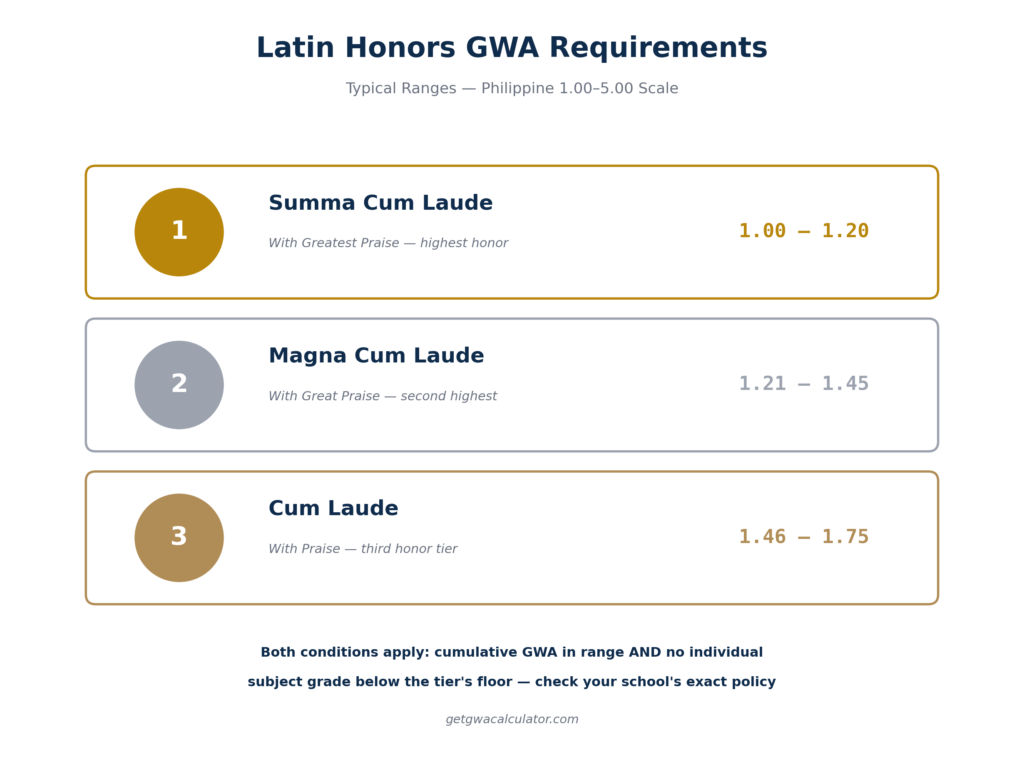
Latin Honors GWA requirements in the Philippines follow a two-part test, not just a single number. To graduate Cum Laude, Magna Cum Laude, or Summa Cum Laude, a student generally needs a cumulative GWA within the tier’s range and no individual subject grade below that tier’s minimum floor, sustained across the entire degree program. Commonly cited ranges on the standard 1.00–5.00 scale are:
- Summa Cum Laude: GWA 1.00–1.20
- Magna Cum Laude: GWA 1.21–1.45
- Cum Laude: GWA 1.46–1.75
These are typical figures, not a fixed national rule the Commission on Higher Education (CHED) gives Philippine universities autonomy to set their own exact cutoffs, so always confirm the specific numbers with your own school’s student handbook or registrar.
Track your running cumulative GWA toward these thresholds with the Cumulative GWA Calculator.
Typical GWA Ranges by Honor Tier
| Honor | Meaning | Typical GWA Range |
|---|---|---|
| Summa Cum Laude | “With Greatest Praise” — highest honor | 1.00 – 1.20 |
| Magna Cum Laude | “With Great Praise” — second highest | 1.21 – 1.45 |
| Cum Laude | “With Praise” — third honor tier | 1.46 – 1.75 |
These figures apply to institutions using the standard descending 1.00–5.00 scale (UP, UST, PUP, NU, and most Philippine colleges). Schools using a different scale compute this differently DLSU uses an ascending 4.00-point GPA system, and Ateneo de Manila uses its own QPI (Quality Point Index) framework so a numeric GWA cutoff from one school cannot be directly compared to another’s without conversion.
The “Two-Part Test” Most Students Miss
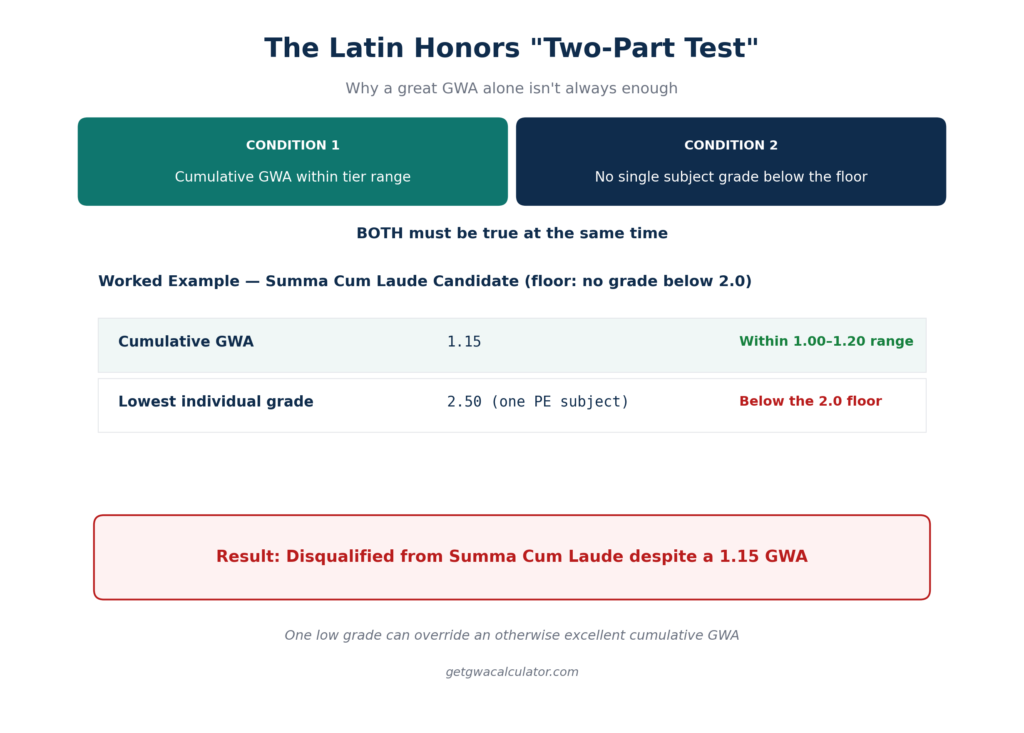
A high cumulative GWA alone does not guarantee Latin Honors. Philippine universities almost universally apply a second, independent condition: no individual subject grade throughout the entire program may fall below a set floor, even if it doesn’t drag the overall GWA out of range.
Both conditions must hold at the same time:
- Cumulative GWA falls within the tier’s range
- No single subject grade falls below that tier’s floor threshold
This catches students who have one unusually weak subject often an elective, a PE class, or a difficult major course buried inside an otherwise excellent transcript. The University of the Philippines (UP) System, for example, is well known for applying a strict no-grade-below-2.0 floor for Summa Cum Laude candidates, regardless of how strong the rest of their record is.
Where These Rules Come From
Latin Honors policy in the Philippines traces back to CHED Memorandum Order No. 8, series of 1976, which first required higher education institutions to base graduation honors on cumulative GWA or GPA while prohibiting failing grades. This early framework has since been refined, most comprehensively in CHED Memorandum Order No. 19, series of 2018 Revised Guidelines for the Award of Honors and Academic Excellence in Higher Education Institutions which remains the current governing framework.
Importantly, CHED does not impose one uniform national GWA cutoff for any honor tier. Because Philippine grading scales vary (1.00–5.00, 4.00-point, or percentage-based systems all coexist), CHED instead requires that each higher education institution’s own criteria be:
- Clearly defined and published in the institution’s Academic Catalog, Student Handbook, or Official Bulletin
- Consistent with the program’s approved curriculum standards
- Based on verifiable academic records
This is why the “typical ranges” above are a useful reference point, not a guarantee your specific university’s published policy is the number that actually counts.
How University Requirements Actually Differ
| University | Grading Scale | Notable Latin Honors Rule |
|---|---|---|
| UP System | 1.00–5.00 (descending) | Strict no-grade-below-2.0 floor for Summa Cum Laude |
| UST, PUP, NU, STI | 1.00–5.00 (descending) | Typically follow the standard tiered ranges above |
| DLSU | 4.00-point (ascending) | Different scale entirely; honors computed on GPA, not GWA |
| Ateneo de Manila | QPI-based | Uses Quality Point Index rather than a direct GWA scale |
Public universities and colleges (SUCs/LUCs) may issue their own supplemental guidelines through their Board of Regents, aligned with CHED’s framework but tailored to institutional priorities. Private universities like Ateneo and DLSU often incorporate additional qualitative factors leadership, research output, or thesis distinction on top of the numeric requirement.
Common Disqualifiers
Even with a qualifying GWA, most Philippine universities will disqualify a candidate from Latin Honors for any of the following, regardless of institution:
- A failing grade (5.00) in any subject at any point in the program
- An unresolved Incomplete (INC) grade
- A dropped subject without valid, approved cause
- Underloading (taking fewer than the standard unit load) in any given semester, at some schools
- Falling short of the school’s minimum residency requirement (a set number of years or units completed at that specific institution)
These conditions exist independently of your GWA computation a transferee with a perfect GWA computed only from their new school, for instance, may still be excluded if they don’t meet residency requirements.
Worked Example
A student maintains a strong academic record throughout their program:
- Cumulative GWA: 1.15 well within the 1.00–1.20 Summa Cum Laude range
- Lowest individual grade: 2.50, earned in a single PE elective
Under a school applying the common no-grade-below-2.0 floor (like UP’s Summa Cum Laude standard), this student does not qualify for Summa Cum Laude, despite an excellent 1.15 GWA the 2.50 grade fails the second condition of the two-part test. Depending on the school’s specific policy, they may still qualify for a lower honor tier, or for Summa Cum Laude at a different institution with a more lenient floor. This is exactly why confirming your own school’s exact published criteria matters more than comparing your GWA to a generic online chart.
FAQ
What GWA do I need for Cum Laude in the Philippines?
Typically 1.46–1.75 on the standard 1.00–5.00 scale, though exact cutoffs are set by each university and should be confirmed with your registrar.
Can I still get Latin Honors if I have one low grade?
It depends on your school’s policy. Most universities apply a “no grade below a set floor” rule in addition to the overall GWA range a single subject grade below that floor can disqualify you from a specific honor tier even with an excellent cumulative GWA.
Does CHED set the same Latin Honors GWA cutoffs for every university?
No. CHED gives higher education institutions autonomy to set their own exact GWA ranges and floor requirements, as long as the criteria are clearly published and consistently applied. The commonly cited ranges (Summa 1.00–1.20, Magna 1.21–1.45, Cum Laude 1.46–1.75) are typical, not universal.
Is Latin Honors the same as Dean’s List?
No. Dean’s List recognizes strong performance in a single semester (commonly a GWA of 1.75 or better, as seen in schools like STI). Latin Honors are awarded once, at graduation, based on your cumulative GWA across the entire program.
Do Senior High School students get Latin Honors?
No. Latin Honors are a college graduation distinction only. Senior High School has its own separate DepEd-governed Academic Excellence Awards system see our guide on Senior High School GWA and honors criteria for how that works.
Conclusion
Latin Honors GWA requirements come down to two things happening at once: your cumulative GWA landing inside the tier’s range, and every single subject grade in your entire academic record staying above that tier’s floor. The commonly cited figures — Summa Cum Laude at 1.00–1.20, Magna Cum Laude at 1.21–1.45, and Cum Laude at 1.46–1.75 are a reliable starting reference, but CHED leaves the exact numbers to each institution, so your own school’s published policy is what ultimately decides your eligibility.
Track your progress toward these Latin Honors GWA requirements every semester with the Cumulative GWA Calculator, and confirm your specific school’s floor-grade policy with your registrar well before your final year not after.
References
- Commission on Higher Education (CHED). CMO No. 19, series of 2018 – Revised Guidelines for the Award of Honors and Academic Excellence in Higher Education Institutions. ched.gov.ph
- Commission on Higher Education (CHED). CMO No. 8, series of 1976 foundational order establishing GWA/GPA-based honors criteria (historical reference).
Note: Exact GWA ranges and floor-grade rules vary by institution. This guide reflects commonly cited figures across Philippine universities; always confirm exact criteria with your own school’s registrar or student handbook.